
If you work in mining, drilling, construction, or any industry that depends on compressed air, chances are you’ve come across the term “screw air compressor.” It’s the workhorse behind pneumatic tools, drilling rigs, sandblasting equipment, and countless industrial processes across India and beyond. Kulmec Compressor provides reliable compressed air solutions designed for demanding industrial applications.
But what exactly is a screw air compressor, and how does it turn ordinary air into a powerful, continuous supply of compressed energy? In this guide, we’ll break down the working principle, key components, types, and applications of screw air compressors, so you can make an informed decision the next time you’re sourcing equipment for your site.
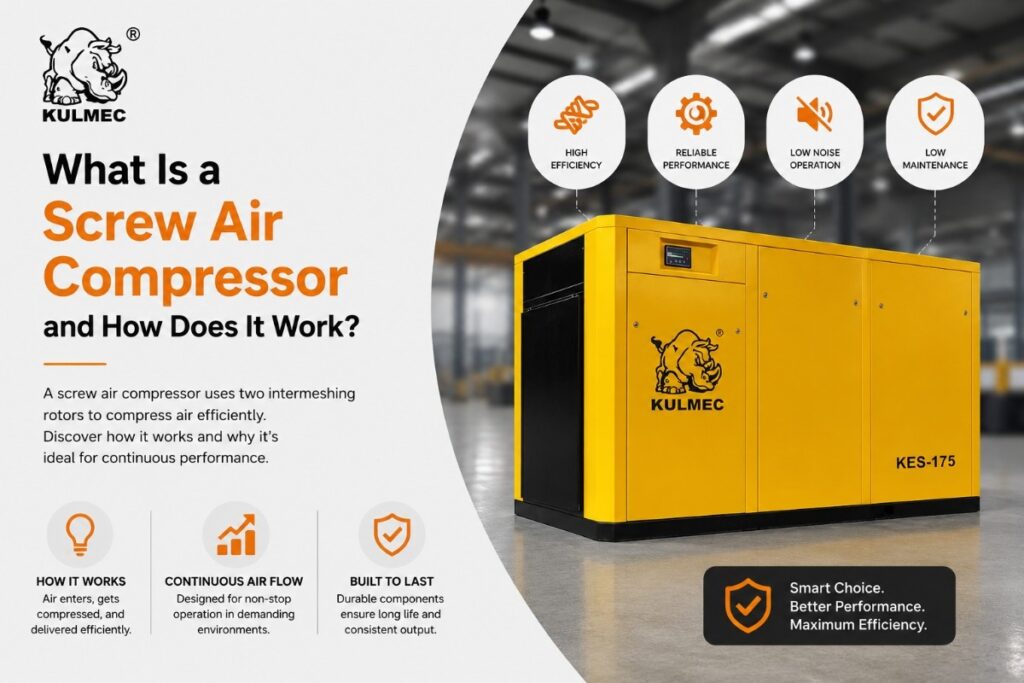
What Is a Screw Air Compressor?
A screw air compressor, also known as a rotary screw compressor, is a type of positive displacement compressor. It uses two interlocking helical rotors, often called screws, that rotate in opposite directions to trap and compress air.
Unlike piston (reciprocating) compressors, which rely on the back-and-forth motion of a piston inside a cylinder, screw compressors use continuous rotary motion. This design difference is what gives screw compressors their signature smooth, non-pulsating airflow and makes them ideal for applications that demand a steady, uninterrupted supply of compressed air, exactly the kind of reliability needed on a mining site or drilling rig.
As a leading screw air compressor manufacturer in India, we build both engine-driven and electric screw compressors designed to handle the tough, continuous-duty demands of mining, drilling, and industrial operations.
How Does a Screw Air Compressor Work?
The working principle of a screw compressor can be understood in four simple stages:
1. Air Intake: Atmospheric air enters the compressor through an inlet valve. This valve controls how much air flows into the compression chamber based on system demand.
2. Compression: Inside the compression chamber, two meshing helical rotors, a male rotor and a female rotor, spin in opposite directions. As they rotate, they trap pockets of air between their lobes and the housing wall.
3. Volume Reduction: As the trapped air moves along the length of the rotors toward the discharge end, the available space steadily shrinks. This reduction in volume causes the air pressure to rise progressively.
4. Discharge: By the time the air reaches the end of the rotors, it has reached the required pressure and is pushed out through the discharge valve, ready to power tools, drills, or industrial systems.
Because the rotors spin continuously rather than moving back and forth, the compressed air output is smooth and steady, with minimal vibration, a major advantage over piston compressors in heavy-duty, round-the-clock operations.
Key Components of a Screw Air Compressor
Understanding the core parts of a screw compressor helps explain why it performs so reliably in demanding environments:
- Inlet Valve: Regulates the volume of air entering the compression chamber.
- Rotors (Screws): The male and female helical rotors that trap and compress the air.
- Compression Chamber: Houses the rotors and manages the compression process.
- Air-Oil Separator: In oil-injected models, separates lubricating oil from the compressed air before discharge.
- Oil Filter: Removes contaminants from the oil so it can be safely recirculated.
- Aftercooler: Cools the hot compressed air, reducing its temperature and condensing excess moisture.
- Moisture Separator: Drains condensed water from the compressed air line.
- Discharge Valve: Releases the final compressed air for use.
Each of these components is engineered to withstand dusty, high-vibration mining and drilling environments, ensuring long service life even under continuous operation.
Types of Screw Air Compressors
Screw compressors aren’t one-size-fits-all. Here are the main variations you’ll come across:
Oil-Injected vs. Oil-Free
Oil-injected (or oil-lubricated) compressors use oil inside the compression chamber to cool, lubricate, and seal the rotors, improving efficiency. Oil-free compressors skip the oil entirely, delivering contaminant-free air for industries where air purity is critical.
Fixed Speed vs. Variable Speed
Fixed-speed compressors run at a constant speed and suit applications with steady, predictable air demand. Variable speed drive (VSD) compressors automatically adjust motor speed to match real-time demand, saving energy when full output isn’t needed.
Engine-Driven vs. Electric Screw Compressors
This is where the choice really matters for mining and drilling operations. Electric screw compressors are efficient and quiet, ideal for sites with reliable grid power. Engine-driven screw compressors, on the other hand, run independently of the electrical grid, making them the go-to choice for remote drilling sites, quarries, and mining locations where power access is limited or unavailable.
Both engine-driven and electric portable screw compressors are manufactured to give customers the flexibility to choose the right power source for their site conditions.
Advantages of Screw Air Compressors
- Continuous Operation: Capable of running 24/7 with a 100% duty cycle, without needing rest periods.
- Smooth, Low-Vibration Output: Rotary motion eliminates the pulsation common in piston compressors.
- High Efficiency: Delivers a steady air supply with minimal energy loss.
- Compact Footprint: Takes up less space than comparable piston units.
- Lower Maintenance: Fewer moving parts mean less wear and longer intervals between servicing.
These advantages are exactly why screw compressors dominate in mining, drilling, and heavy industrial applications where downtime simply isn’t an option.
Common Applications Across Industries
Screw air compressors power a wide range of operations, including:
- Mining & Drilling: Powering rock drills, blast-hole equipment, and pneumatic tools on-site.
- Construction & Infrastructure: Running jackhammers, nail guns, and other heavy-duty pneumatic tools.
- Sandblasting: Supplying consistent high-pressure air for surface preparation and cleaning.
- Cement & Bulk Material Transfer: Moving fly ash and other bulk materials between silos.
- General Manufacturing: Driving assembly lines, packaging equipment, and pneumatic machinery.
Screw Compressor vs. Piston (Reciprocating) Compressor
| Factor | Screw Compressor | Piston Compressor |
| Motion | Continuous rotary | Reciprocating (back-and-forth) |
| Duty Cycle | Suited for 100% continuous use | Better for intermittent use |
| Noise & Vibration | Low | Higher |
| Maintenance | Lower, fewer moving parts | Higher, more wear parts |
| Best For | Mining, drilling, industrial 24/7 use | Small workshops, occasional use |
If your operation demands a non-stop, reliable air supply, like most mining and drilling sites do, a screw compressor is almost always the better long-term investment.
How to Choose the Right Screw Air Compressor
A few factors should guide your decision:
- Power Source Availability: Choose an electric screw compressor for grid-connected sites, or an engine-driven unit for remote locations without stable power access.
- Pressure & Flow Requirements (CFM/PSI): Match the compressor’s output to the tools and equipment you plan to run.
- Portability Needs: Mobile drilling and mining operations often require towable or skid-mounted units.
- Operating Environment: Dusty, high-vibration sites need ruggedly built compressors designed for harsh conditions.
As a trusted screw air compressor manufacturer in India, Kulmec Compressor offers a wide range of engine-driven, electric, and stationary screw compressors engineered specifically for mining, drilling, and industrial use, helping you match the right machine to your exact site requirements.
Maintenance Tips to Extend Compressor Life
- Replace filters regularly to keep contaminants out of the system.
- Check oil levels daily to ensure proper lubrication and cooling.
- Conduct periodic oil analysis to catch contamination early.
- Inspect drainage points to prevent moisture buildup and corrosion.
- Monitor operating temperature to avoid overheating.
- Schedule professional servicing if you notice unusual noise, vibration, or pressure fluctuations.
Routine maintenance not only extends the compressor’s lifespan but also protects your investment and minimizes costly downtime on-site.
FAQs on Screw Air Compressors
1. Is a screw compressor better than a piston compressor?
For continuous heavy-duty use, yes, screw compressors offer smoother operation, lower vibration, and better reliability. Piston compressors remain a good fit for lighter, intermittent tasks.
2. How long do screw compressors last?
With proper maintenance, a well-built screw compressor can last 10–20 years or more.
3. Can screw compressors run continuously?
Yes, screw compressors are designed for a 100% duty cycle and can operate around the clock without rest periods.
4. What’s the difference between engine-driven and electric screw compressors?
Engine-driven compressors run independently of grid power, making them ideal for remote sites, while electric compressors are quieter and more efficient where stable power is available.
5. Do screw compressors need oil?
Most industrial screw compressors are oil-injected for better cooling and sealing, though oil-free models are available for applications requiring contaminant-free air.
Conclusion
Screw air compressors have become the backbone of modern mining, drilling, and industrial operations thanks to their continuous duty cycle, efficiency, and reliability. Whether you need an electric unit for a grid-connected facility or an engine-driven compressor for a remote site, understanding how these machines work helps you choose the right equipment for your operation.
Kulmec has spent years engineering rugged, high-performance screw air compressors built specifically for mining, drilling, and industrial environments across India and beyond. As a CE-certified screw air compressor manufacturer in India, we combine quality materials, in-house quality control, and field-tested engineering to deliver compressors that keep your operations running.
Looking for the right screw air compressor for your site? Get in touch with us today for expert guidance and a solution built for your needs.