
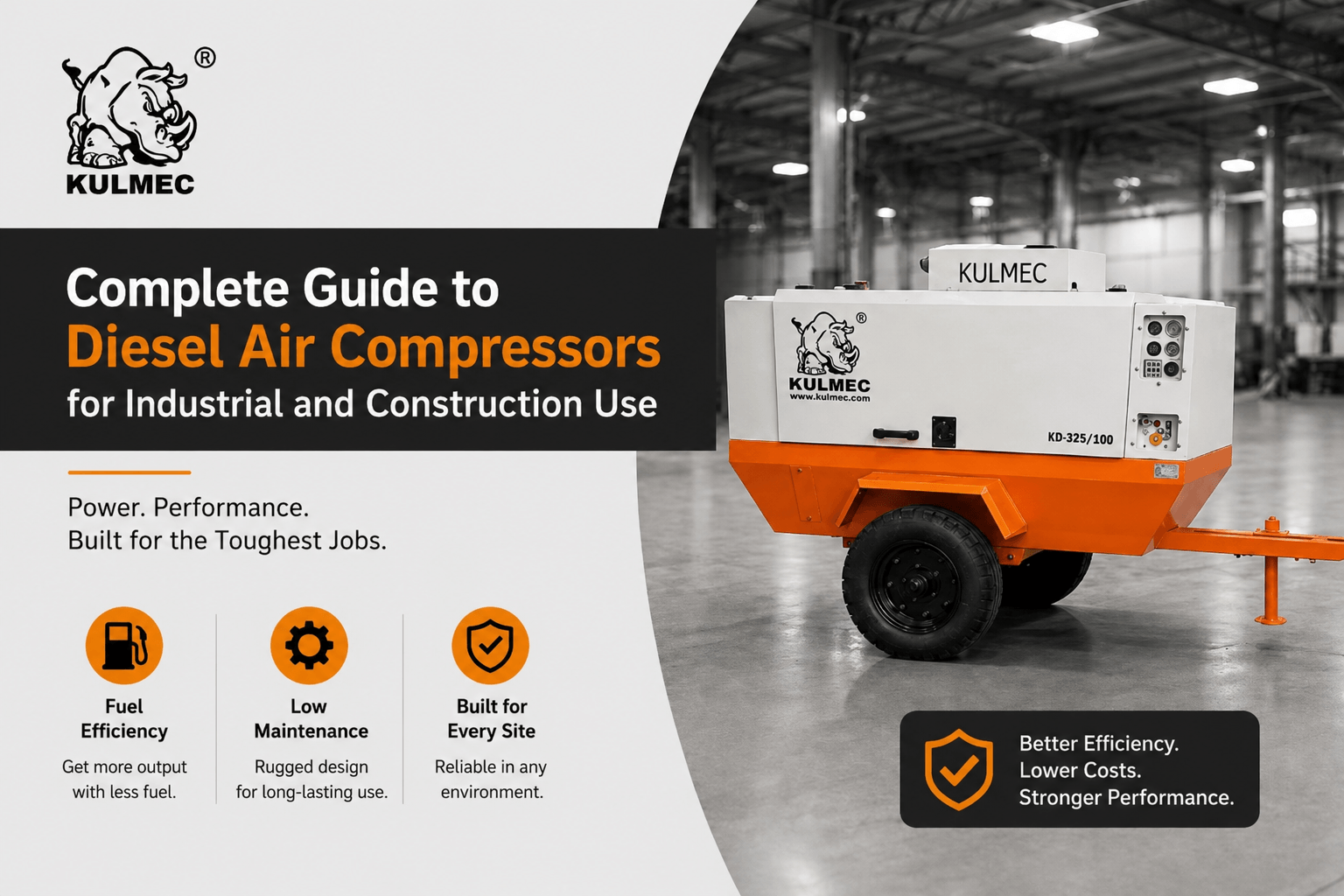
If you work in mining, drilling, construction, or remote industrial sites, a diesel air compressor can be an essential machine. Unlike electric compressors, it does not need a stable power supply and can work at quarries, construction sites, borewell locations, and mines. As a trusted Diesel Air Compressor manufacturer in India, Kulmec Compressor offers engine-driven screw and reciprocating compressors designed for demanding conditions.
This guide explains what a diesel air compressor is, how to choose the right model, how to operate it safely, and how to maintain it properly. With the right compressor and regular maintenance, you can reduce breakdowns, avoid unnecessary downtime, and keep your projects running efficiently.

What Is a Diesel Air Compressor?
A diesel air compressor is a machine that uses a diesel engine, instead of an electric motor to compress atmospheric air into a pressurized form that can power pneumatic tools, drilling rigs, sandblasting equipment, and other industrial machinery. Because it’s self-contained, it doesn’t rely on grid power. You fuel it, start it, and it runs. This makes it the natural choice for mining sites, remote construction zones, road projects, and any location where electricity is unreliable or simply unavailable.
Types of Diesel Air Compressors
Not all diesel compressors are built the same. Broadly, they fall into a few categories:
- Diesel screw (rotary) compressors – Use twin rotating screws to compress air continuously. They deliver a steady, high-volume airflow and are ideal for drilling, mining, and sandblasting applications that need consistent pressure over long shifts.
- Diesel reciprocating (piston) compressors – Use pistons to compress air in bursts. These are typically used for lower-volume, higher-pressure applications and are known for their rugged, simple design.
- Portable vs. stationary units – Portable diesel compressors are mounted on wheels or skids for easy transport between sites, while stationary units are fixed in place for continuous plant or facility use.
Understanding which category fits your workload is the first real decision point before you even start comparing models or specs.
How to Choose the Right Diesel Air Compressor
Choosing the right unit isn’t just about horsepower, it’s about matching the machine to your job site, your tools, and your budget. Here’s what actually matters:
1. CFM and pressure requirements: Every pneumatic tool or rig has a minimum air volume (CFM) and pressure (PSI/bar) requirement. Undersizing your compressor means your tools will underperform; oversizing wastes fuel and money. Check the air consumption specs of the equipment you’re running before you shortlist a compressor.
2. Application type: A compressor built for surface drilling isn’t necessarily the best fit for sandblasting or general industrial use. Match the compressor category, screw, reciprocating, or booster to your actual application.
3. Portability and site conditions: If you’re moving between remote job sites, a trailer-mounted or skid-mounted portable unit makes far more sense than a stationary compressor. Consider terrain, transport distance, and how often the unit needs to be relocated.
4. Fuel efficiency and engine type: Diesel engines vary in fuel consumption and emissions compliance. A more fuel-efficient engine reduces your operating cost significantly over the life of the machine, especially on long-duration projects.
5. Duty cycle and build quality: Mining and drilling environments are harsh, dust, vibration, and continuous heavy use. Look for compressors built with industrial-grade components and a duty cycle rated for continuous operation, not intermittent use.
Key Specifications to Check Before Buying
Before finalizing a purchase, review these specs carefully on the manufacturer’s data sheet:
- CFM (cubic feet per minute) — the volume of air delivered
- Working pressure (PSI or bar) — how much pressure the unit sustains
- Engine horsepower (HP) — the power driving the compression
- Tank/receiver size — affects air storage and delivery consistency
- Fuel tank capacity — determines runtime between refuels
Comparing these numbers across a few models will tell you far more than marketing brochures alone. It also helps to ask the supplier for real-world performance data from similar job sites rather than relying only on lab-tested figures, since dust, altitude, and ambient temperature can all affect a compressor’s actual output in the field.
How to Operate a Diesel Air Compressor Safely
Operating a diesel compressor correctly protects both your equipment and your crew.
Pre-start checks: Inspect oil levels, coolant, fuel, air filters, and hose connections before every startup. Look for leaks, worn belts, or loose fittings.
Startup and shutdown procedure: Start the engine and let it idle briefly before engaging the compressor unit, this allows oil to circulate properly. When shutting down, unload the compressor first, then let the engine cool for a minute before switching it off completely.
Safe operating practices on-site: Never exceed the rated pressure, keep the unit on stable, level ground, ensure proper ventilation if operating in enclosed spaces, and keep unauthorized personnel away from moving parts and hot surfaces.
Diesel Air Compressor Maintenance Guide
Regular maintenance is what separates a compressor that lasts a decade from one that fails within a year.
- Daily checks: Oil level, fuel level, air filter condition, and visual inspection for leaks.
- Weekly checks: Belt tension, hose integrity, and coolant levels.
- Scheduled servicing: Follow the manufacturer’s oil and filter change intervals, typically every 250–500 running hours, depending on usage conditions.
- Wear parts to monitor: Air filters, oil filters, separator elements, and belts should be replaced proactively rather than reactively.
A consistent maintenance routine is one of the simplest ways to avoid costly downtime on an active job site.
Common Problems & Troubleshooting
Even well-maintained units run into occasional issues. Here are the most common ones:
- Overheating — Usually caused by low oil levels, blocked cooling fins, or operating beyond the duty cycle. Check coolant and airflow around the radiator.
- Pressure loss — Often due to worn seals, air leaks in hose connections, or a clogged air filter restricting intake.
- Starting issues — Typically linked to fuel quality, battery charge, or a clogged fuel filter.
Catching these early through routine inspection prevents small issues from becoming expensive repairs. Keeping a simple daily log of running hours, oil top-ups, and any unusual noise or vibration also helps operators and technicians spot patterns before a minor issue turns into a major breakdown.
Cost & ROI Considerations
Beyond the purchase price, the real cost of owning a diesel air compressor comes down to fuel consumption, service intervals, spare parts availability, and downtime. A slightly higher upfront investment in a well-built, fuel-efficient unit often pays for itself within a year or two through lower running costs and fewer breakdowns.
When comparing quotes, ask suppliers for the compressor’s fuel consumption per hour at rated load, expected service intervals, and the availability of spare parts and local support, these factors affect your total cost of ownership far more than the sticker price alone.
Diesel vs. Electric Air Compressors: Which Should You Choose?
If your site has stable grid power and you’re running fixed equipment indoors, an electric compressor can be more economical and quieter. But if you’re working remotely, off-grid, or across multiple mobile sites, mining, drilling, or infrastructure projects, a diesel-driven unit remains the more practical and reliable choice, since it doesn’t depend on external power at all.
Extending the Life of Your Diesel Air Compressor
To get the maximum return on your investment: stick to the recommended service schedule, use genuine filters and fluids, avoid running the unit beyond its rated duty cycle, store it properly when not in use, and train operators on correct startup/shutdown procedures. A well-maintained diesel compressor can reliably serve a business for well over a decade.
Why Kulmec Compressor
For businesses looking for a dependable Diesel Air Compressor in India, Kulmec Compressor designs and manufactures engine-driven screw and reciprocating compressors built specifically for demanding mining, drilling, and industrial environments.
As an experienced Diesel Air Compressor manufacturer in India, Kulmec combines rugged engineering with a wide range of models to match different CFM, pressure, and application needs, backed by an in-house quality control team and a growing dealer network across India and abroad.
Conclusion
A diesel air compressor is a long-term investment in your operation’s productivity, so choosing the right machine and maintaining it properly matters as much as the upfront price tag. Whether you’re drilling, sandblasting, or running heavy industrial equipment, the right compressor keeps your site running without unplanned downtime.If you’re evaluating your next diesel compressor purchase, reach out to the Kulmec team to find the right model for your site conditions and workload.