
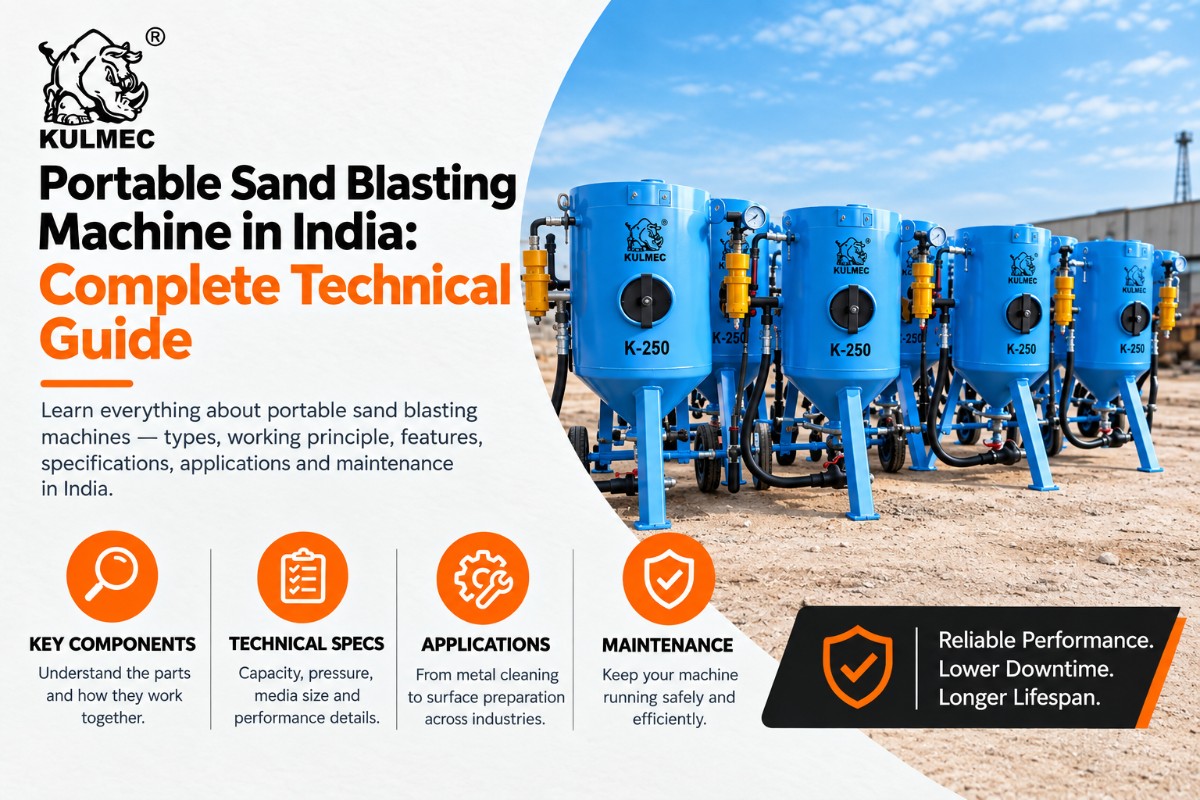
Surface preparation makes or breaks the lifespan of any coating, weld, or structure. Rust, old paint, and mill scale don’t just look bad, they cause premature corrosion and coating failure. That’s why a portable sand blasting machine has become standard equipment across India’s mining, infrastructure, oil & gas, and shipbuilding sectors.
With nearly three decades of industry experience, Kulmec Compressor has helped businesses choose reliable solutions for fast, safe, and cost-effective surface preparation. As a trusted Sandblasting Equipment Manufacturer in India, the company focuses on equipment designed to meet the practical needs of different industrial applications. This guide explains how these machines work, what to look for, and how to choose the right one for your project.
What Is a Portable Sand Blasting Machine?
A portable sand blasting machine, also called an abrasive blast pot, propels abrasive media through a hose using compressed air to clean, roughen, or strip a surface. Unlike fixed blast rooms, portable units mount on wheels so crews can move them directly to bridges, tanks, pipelines, or heavy equipment on-site which is exactly why demand for portable blasting equipment has grown steadily across Indian infrastructure and industrial projects.
How a Portable Abrasive Sand Blasting Machine Works
The process is straightforward but relies on precision engineering:
- Air compressor supply – A compressor feeds compressed air into the blast pot at a set pressure.
- Abrasive loading – Abrasive media (sand, garnet, steel grit, etc.) is loaded through a concave top sealed by a heavy-duty pop-up valve.
- Metering valve control – A metering valve regulates how much abrasive mixes with the air stream, ensuring consistent flow.
- Conical bottom design – This shape directs all abrasive toward the metering valve, preventing residue buildup.
- Nozzle discharge – The air-abrasive mixture exits through a nozzle at high velocity, blasting away rust, paint, or scale.
- Remote control operation – A remote handle with a dead-man switch lets the operator start/stop the blast instantly for safety.
Getting each stage right affects abrasive consumption, surface finish quality, and operator safety, which is why component quality matters as much as the core design.
Key Components and Features to Look For
Not all blast pots are built equally. When evaluating a machine, check for:
- Heavy-gauge steel fabrication — thicker tanks (6mm to 12mm depending on size) withstand years of rough site conditions
- Hydrotested construction — pressure-tested before dispatch to confirm structural safety
- Certified pressure gauges and safety valves — non-negotiable for compliance and operator protection
- Moisture/water separator — removes water from incoming compressed air so abrasive doesn’t clump or damage the surface
- Flexible hydraulic/rubber hoses — easier to reposition and replace than rigid metal lines
- Quick claw couplings — speed up setup and breakdown between jobs
- Heavy-duty wheels and lifting points — for mobility across uneven job sites and crane loading
- Powder-coated finish — resists rust and extends the equipment’s own working life
- CE certification — confirms the unit meets recognized safety and build standards
Types of Abrasive Media Used in India
The abrasive you choose affects both blasting speed and surface finish:
- Copper slag – Widely used for shipyards and structural steel; economical and effective on heavy rust
- Garnet – Low dust, reusable, ideal for controlled environments and sensitive surfaces
- Steel grit/shot – Aggressive cleaning for thick scale, often reused in enclosed blast rooms
- Glass beads – Gentler finish, common for cosmetic or light-duty cleaning
Matching abrasive type to your blast pot’s metering valve and nozzle size keeps consumption efficient and avoids unnecessary wear.
Portable Sand Blasting Machine Models and Specifications
Blast pot capacity should match your project scale, a small K-50 unit is overkill for a full bridge job, and a Jumbo unit is unnecessary for touch-up work. A typical model range looks like this:
| Model | Volume | Abrasive Capacity | Tank Diameter | Weight | Nozzles Compatible |
| K-50 (Small) | 38L | 50kg | 254mm | 42kg | 1 |
| K-50 (Large) | 96L | 100kg | 406mm | 90kg | 1 |
| K-250 | 224L | 250kg | 609mm | 180kg | 1 |
| K-400 | 406L | 500kg | 762mm | 260kg | 1 |
| Jumbo 4000 | 3000L | 4000kg | 1828mm | 2100kg | Up to 4 |
Larger tanks reduce reload frequency and support multiple nozzles for crews working simultaneously, a major time saver on large-scale infrastructure and refinery projects.
Compressor and Air Requirement Guide
Your blast pot is only as effective as the air compressor feeding it. Nozzle size determines CFM (cubic feet per minute) requirements, a larger nozzle diameter demands significantly more air volume to maintain blasting pressure. Undersized compressors cause pressure drops, inconsistent blasting, and wasted abrasive.
It’s worth pairing your blast pot with a compressor sized specifically for your nozzle and hose length, since compressed air supply, not the blast pot itself, is usually the limiting factor in overall productivity.
Industry Applications in India
Portable abrasive blasting machines see heavy use across:
- Bridge refurbishment — removing old paint and corrosion before recoating
- Oil, gas, and refinery plants — pipeline and tank surface prep
- Shipyards — hull cleaning and maintenance
- Railways — structural steel and rolling stock upkeep
- Mining and heavy equipment — stripping rust from machinery and structural frames
Mobility is the common thread, these projects can’t bring the work to a blast room, so the blast room has to come to the work.
Safety Standards and Certifications
Sandblasting involves high-pressure air, abrasive particulate, and potential silica exposure, so certification isn’t optional. Look for:
- CE-approved construction
- Hydrotesting documentation
- Certified pressure gauges and safety relief valves
- Dead-man remote controls that cut air supply the moment the operator releases the handle
- Proper PPE for operators (blasting hoods, gloves, protective suits)
How to Choose the Right Portable Sand Blasting Machine
Work through these questions before buying:
- What’s the project scale? Small maintenance jobs need less tank capacity than large infrastructure work.
- What abrasive will you use? Confirm the metering valve and hose are rated for it.
- How mobile does it need to be? Rough terrain calls for heavy-duty wheels and lifting points.
- Do you already own a compatible air compressor? If not, budget for one sized to your nozzle requirements.
- Is the manufacturer certified and experienced? Look for CE certification, hydrotesting records, and a manufacturing track record.
Maintenance and Operating Best Practices
Routine upkeep extends equipment life and keeps blasting consistent:
- Inspect the nozzle regularly, wear increases air consumption and reduces blast velocity
- Drain the moisture separator to prevent damp abrasive
- Check hose couplings and valves for leaks before each shift
- Clean the inspection hole and conical bottom to prevent abrasive clogging
- Store the unit covered to protect the powder-coated finish from weather
Why Choose Kulmec Compressor
Founded in 1996 and based in Gandhinagar, Gujarat, Kulmec Compressor has built a reputation as a dependable Sandblasting Equipment Manufacturer in India, alongside its range of air compressors, air boosters, and pneumatic crawler drills. Every unit goes through in-house quality control and hydrotesting before dispatch, and the company holds CE certification across its product range.
Kulmec’s client base includes major names such as Cairn India, GAIL, Tata Power, Hindustan Zinc, and Indian Railways, a track record built on durable fabrication and responsive after-sales support. Whether you need a compact K-50 for touch-up work or a Jumbo 4000 for continuous large-scale blasting, Kulmec Compressor engineers each unit for Indian site conditions and export markets alike.
FAQs
1. What’s the difference between wet and dry sandblasting?
Dry blasting uses abrasive and compressed air alone, while wet blasting introduces water to reduce dust, useful in populated or enclosed areas.
2. What CFM compressor do I need for a portable blast pot?
It depends on nozzle size; larger nozzles need substantially higher CFM to maintain consistent blasting pressure. Check your nozzle’s rated air consumption before selecting a compressor.
3. Is rental available for sandblasting machines in India?
Some suppliers offer rental options for short-term projects, but for regular or heavy-duty use, purchasing from an established manufacturer is usually more cost-effective long term.
4. How often should abrasive metering valves be replaced?
Inspect them each shift; replace when wear affects consistent abrasive flow, typically every few hundred operating hours depending on abrasive type.
Conclusion
A portable sand blasting machine is only as good as its build quality, component durability, and the compressor supporting it. From tank fabrication to safety certification, every detail affects performance on-site.
As an established Sandblasting Equipment Manufacturer in India, Kulmec Compressor combines nearly 30 years of manufacturing experience with CE-certified builds trusted by major Indian industrial and infrastructure players. To find the right model and compressor pairing for your project, request a quote or download the brochure directly from Kulmec Compressor’s website.